Earth and Enviornmental Science Porfolio Project
 

What Causes The Weather

The sun heats the earth, as we all know. Weather processes such as wind, clouds, and precipitation are due to the atmosphere responding to uneven heating of the earth due to the sun. This uneven heating causes air currents or wind to develop. This then moves the heat to places with higher temperature and lower temperature. High pressure and low pressure areas, wind, clouds, and precipitation are all caused by the uneven heating from the sun. This results in the redistribution process. There are two types of redistribution, vertical and horizontal; vertical is caused by solar heating of the surface of the earth causes an unstable atmosphere, causing vertical air currents. Horizontal is caused by the way the sun shines on the spherical earth; this causes horizontal temperature which causes pressure differences.

www.weatherquestions.com/What_causes_weather.htm

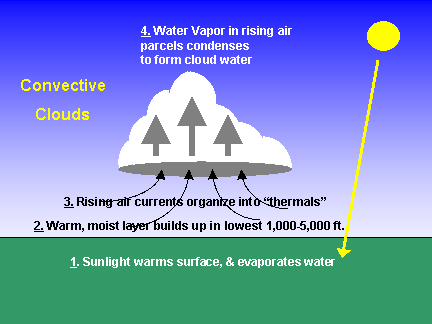
Cloud Formation and Types- Clouds form when rising air through expantion cools to the point that some of the water molecules clump together than they were torn apart with their thermal energy. The water evaporates from the heat of the sun and rises and condences into clouds.


Orographic Uplifting- This is where the flow of air is forced up over highlands and mountains. Moist air being forced begins to cool, concequently condensation forms and rain or snow begins to fall.           http://www.geography-dictionary.org/OROGRAPHIC_LIFTING

Convectional Uplifting- The vertical lifting of parcels of air through convective heating of the atmosphere. This process can initiate  adiabatic processes inside the air parcel.          http://geography.geography-dictionary.org/Convectional_Lifting

Frontal Uplifting- Lifting of a warmer or less dense air mass by a colder or more dense air mass at a frontal transitional zone. http://geography.geography-dictionary.org/Physical-Geography-Dictionary/Frontal_Lifting

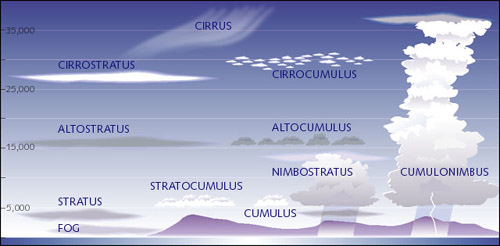
Main 3 Types of Clouds-  1). Stratus- are uniform grayish clouds that often cover the entire sky,they resemble fog that does not reach the ground. Usually no precipitation falls from stratus clouds, but sometimes they may. When a thick fog "lifts," the resulting clouds are low stratus.   

                                                                                                         2). Cumulus Clouds- this cloud is a fair weather cloud and are usally seen at low altitudes. If there is enough insabability they can form into cumulonimbos cloud, which is a storm producing cloud.    
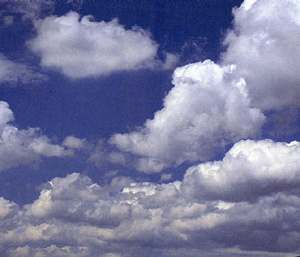
    

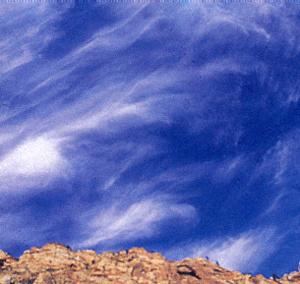
 3). Cirrus Cloud- these are thin wispy clouds that form at 18,000 feet above. These clouds are blown by strong westerly winds and generally move from east to west. These clouds form when water vapor undergoes decomposition and forms ice crystals.


Types of Storm Systems

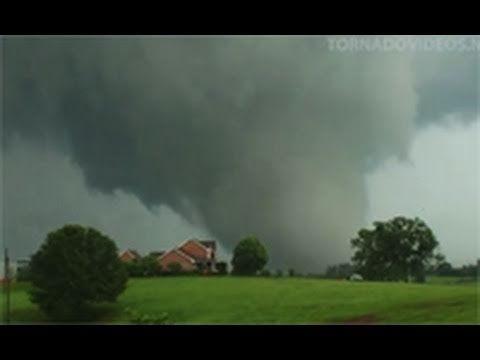
1. Tornadoes- Tornadoes have high winds up to 300 miles an hour and cause a lot of damage to the area it hits. It is a type of cyclone and is funnel shaped. They also have very heavy rains and a lot of lightning. In April of 2011 there was a tornado outbreak of about 326.

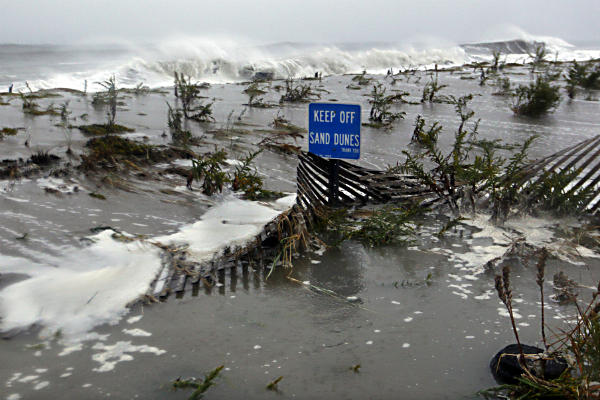
2. Hurricanes- Hurricanes are also cyclone storm and are very severe. It is accompanied with heavy rain. It can cause massive destruction and is the deadliest natural disaster. In 2012 hurricane Sandy hit the US and killed 149 people. 8,000,000 people were without power from South Carolina to Maine.

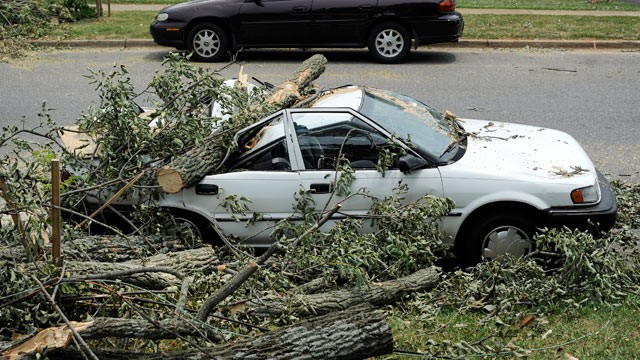
3. Derecho Storms- This is a storm that is a large, violent, fast moving complex of thunder storms that follow one another along a path at least 240 miles. This type of storm is very hard to predict, and often form around an hot air mass near a jet stream  The last storm that took place was in Washington, it killed 17 people and created alot of damage.

www.stormdamagecenter.org/common-storm-types.html


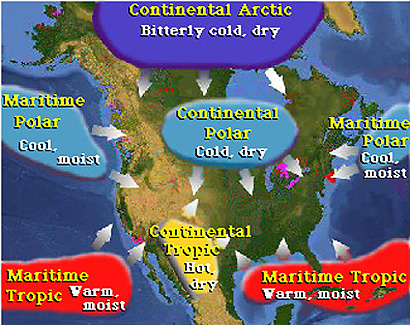
Air Masses- There are 5 basic types of air masses, they include; Continental Polar, Continental Arctic,  Maritime Polar, Maritime Tropical, and Continental Tropical. Air Masses are large bodies of air that are horizontally uniform, and can cover a continent.

- Continental Polar (cP) are cold, dry, and stable. The originate over Northern Canada and Alaska. Precipitation occurs in small amounts because this mass is mostly dry. 

-Maritime Polar (mP) these masses originate over Asia and move westward over the pacific to collect warmth and moisture.

- Maritime Tropical (mT) this mass originates over the subtropical pacific and are warm, moist and usually unstable. Some originate over the Gulf of Mexico and Caribbean Sea. They also can be associated with fog and low clouds.

- Continental Tropical (cT) these masses originate in Northern Mexico. They are characterized by clear skies and no rain. If this moves to the Great Planes it can cause a severe drought. 

- Continental Arctic (cA) these air masses are cold and dry. 


ttp://okfirst.mesonet.org/train/meteorology/AirMasses.html


http://weather.about.com/od/atmospherebasics/a/airmasstypes.htm


 Jet Streams- a jet stream is a current of rapidly moving air that is usually several thousand miles long and wide but thin. There are two types of jet streams, they are the Polar and Subtropical jet stream. 


 - Polar Jet Stream This is the region of maximum troposhperic flow, this stream moves west to east.

- Subtropical Jet Stream This is located at the poleward limit of the equatorial air.  

 http://abyss.uoregon.edu/~js/glossary/jet_streams.html

 Frontal Systems-  A front is a narrow transition zone between air masses with differing densities. The two main air characteristics that define one air mass from the next are temperature and moisture content or humidity. When two different air masses approach each other, the zone where the air masses meet is called a front or frontal boundary. There are four types of Frontal Systems. 

Warm Fronts- A warm front occurs when a cold air mass slowly moves away and is replaced with a warm mass. As the warmer and less dense air moves in to replace cooler and more dense air, a sloped transition zone between the air masses forms. The less dense warm air moves up and over the cooler air causing moisture in the warm air to condense as it rises. This condensation causes the formation of clouds along the warm front. As the warm front continues to approach an area, precipitation is likely.  

Cold Fronts-Cold air masses that push into an area of warm air will often cause a rapid uplift in the warmer air. This is due to the lighter weight of warm air.

Stationary Fronts-A stationary front can be considered a stalled front. There is little forward movement in a stationary front. Often, the weather will remain the same for days if a stationary front stays over an area.

Occluded Fronts- An occluded front is a composite of two frontal systems that merge as a result of occulsion. Cold fronts generally move faster than warm fronts. In fact, the speed of a cold front is about double that of a typical warm front. As a result, a cold front will sometimes overtake an existing warm front. Essentially, an occluded front forms as three air masses meet.

http://weather.about.com/od/f/g/front_glossary.htm


Philosophy


This free website was made using Yola.

No HTML skills required. Build your website in minutes.

Go to www.yola.com and sign up today!

Make a free website with Yola